
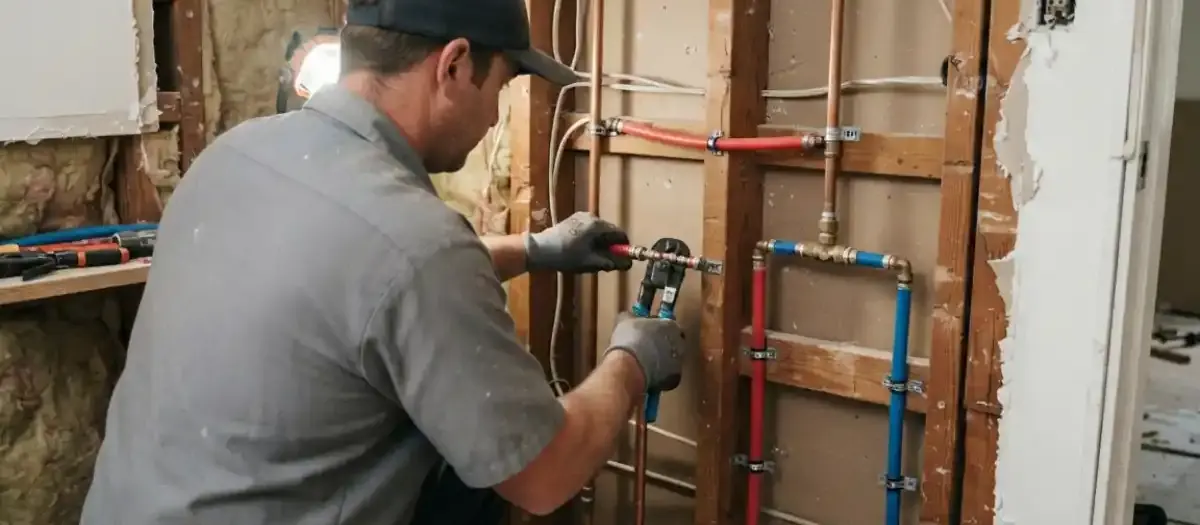
Signs a house is ready for a repipe
One leak is a repair. Several leaks in a short time, rust-tinted water, falling pressure and visible corrosion on exposed pipe suggest the system is wearing out. Each repair can strain neighboring sections.
If you are seeing pinhole leaks in copper or recurring leaks in older galvanized steel, ask us for an assessment. We will tell you plainly if spot repairs will still hold.
Pipe types we see and what to expect
Material and age shape the plan.
| Material | Typical issue | Our approach |
|---|---|---|
| Galvanized steel | Interior rust narrows the pipe and reduces pressure | Replace the affected runs |
| Polybutylene (gray plastic) | Fittings can fail with age | Consider replacing throughout |
| Copper | Pinhole leaks or corrosion at joints | Repair or replace sections or the whole system |
| CPVC | Becomes brittle with age | Replace failing runs |
Think a repipe may be due?
Call and we will inspect the system and give you a straight answer.
Why age matters in older Easley homes
Easley's older housing stock includes homes from the mill and railroad years as well as mid-century neighborhoods. Pipe from those decades may be galvanized steel, which corrodes from the inside. Homes built or renovated roughly between the late 1970s and mid 1990s may contain polybutylene.
We cannot tell a pipe's material by looking at the house from the street, so we inspect accessible runs in the crawlspace, basement or garage and show you what we find.
Slab homes and crawlspace homes
A house on a crawlspace usually allows easy access, so most repiping happens below the floor with little wall damage. A house on a slab is trickier because some lines run in or under concrete.
For slab homes, we often reroute new lines through attics or walls instead of breaking the slab. See slab leak repair for the repair side of slab problems.
What a repipe looks like from start to finish
We plan the job to minimize disruption.
- Walk-through to map pipe runs, fixtures and access points.
- Written price and scope, including drywall access and patching.
- Water shutoff and installation of new supply lines in stages.
- Pressure test every run before closing access points.
- Final fixture hookup, system flush and a walk-through with you.
Most homes can keep partial water service during the day. We explain the plan when we quote.
What the local water means for new pipe
Easley Combined Utilities adds polyphosphate for corrosion control and keeps its pH near 7.2, according to its 2023 water quality report. Soft, near-neutral water is generally gentle on both copper and PEX. Your house pipe choice depends on your preference and budget more than on local water chemistry.
Questions to ask before you commit to a repipe
The answers shape both the price and the result.
- Which pipe material do you recommend for my house, and why?
- How many days will the water be off, and for how long each day?
- Who repairs and paints the drywall afterward?
- What permits are needed and who handles them?
- What does the warranty cover, in writing?
Repipe now or later
A planned repipe is cheaper than an emergency one. When a pipe has already failed and water has damaged floors and walls, the repipe bill sits on top of the repair bill. Planning ahead lets you pick the season, line up the drywall work and compare quotes.
That does not mean every older house needs a repipe now. A house with pipes in good shape can wait. A camera look at accessible lines, a pressure test and a review of the leak history tell us whether the time is now or later.
Standards for the pipe we install
PEX tubing is made to ASTM F876, copper water tube to ASTM B88, and drinking water components are tested to NSF/ANSI 61. We choose a material that carries those listings and meets the IPC as adopted in South Carolina.
What decides repipe pricing
We quote the whole job in writing.
Repiping questions
Recurring leaks, rusty water, low pressure and visible corrosion are the main signs. An inspection of accessible pipe gives you a clear answer.
Some homes built between the late 1970s and mid 1990s used it, and its fittings can fail with age. We can check whether your home has it.
Yes, usually by rerouting new lines overhead or through walls instead of breaking the slab.
Most homes take a few days, depending on size and access. We give a realistic schedule with the quote.
Both work well. PEX is flexible, resists corrosion and installs faster. Copper has a long track record. We explain trade-offs for your home.
If water is leaking right now, see burst pipe repair. We also repipe for homes in Pickens and Liberty.