
The meter test: is water leaking right now?
Many leak calls begin with a number, not a puddle. The water bill jumped, or the meter dial moves when nobody is home. You can check this yourself. Turn off every faucet and appliance, then watch the small leak indicator on your water meter for a few minutes.
If it moves, water is escaping somewhere between the meter and your fixtures. That could be a toilet flapper, an irrigation line, a pipe in the wall or a buried service line. The next step is working out which.
Symptoms that point to a hidden leak
You do not need to see water to have a leak. These signs show up first.
- A water bill that rises without a change in how you live.
- The meter dial turning with all water off.
- Warm spots on a floor, which can mean a hot line leaking under a slab.
- Musty smells, bubbling paint or stained ceilings and walls.
- The sound of running water when nothing is on.
- Low water pressure that appears suddenly.
Water bill jumped or a ceiling is wet?
Call the 24/7 line and we will find it without tearing out half your house.
How we trace a leak without tearing things apart
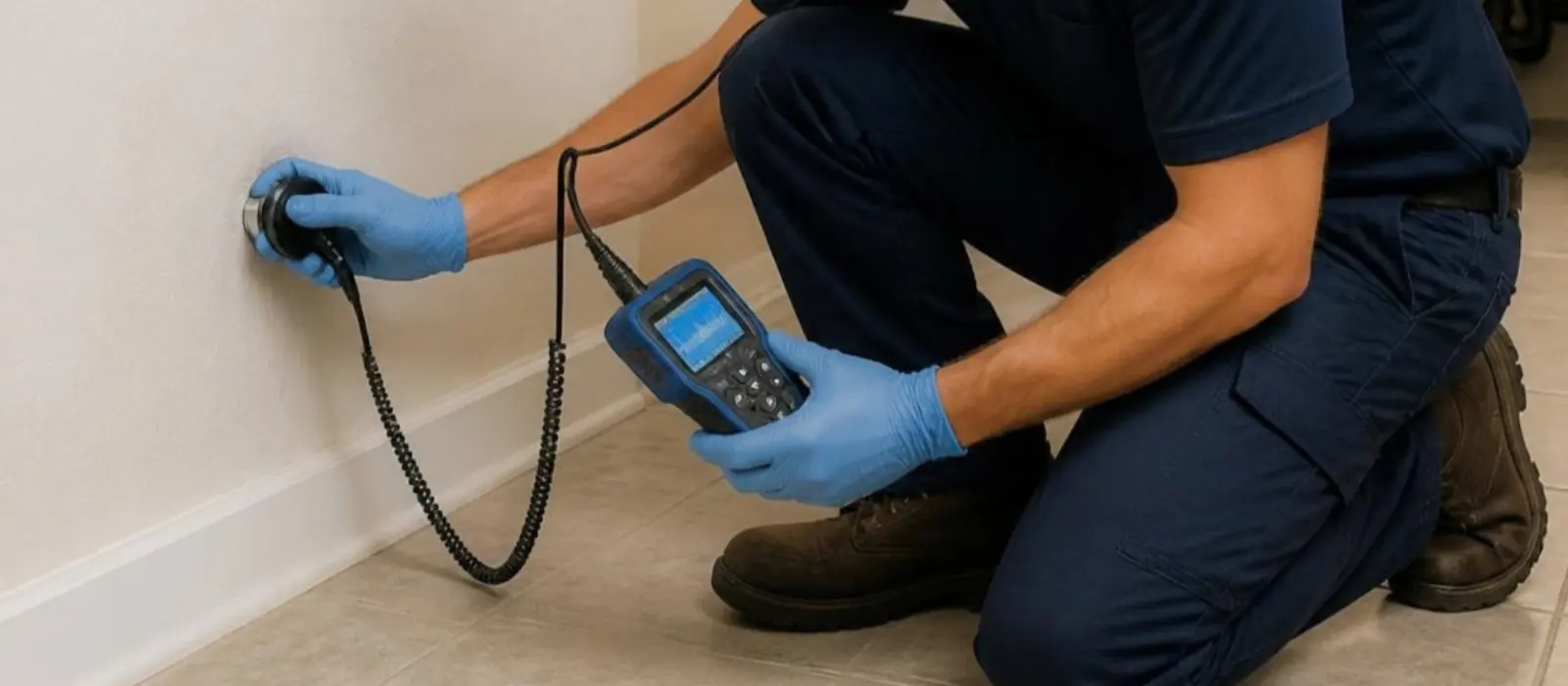
Several tools work together. The table shows what each does.
| Tool | What it does | Used for |
|---|---|---|
| Pressure test | Isolates a zone and watches for a drop | Narrowing whether the leak is in supply or drain lines |
| Acoustic listening | Hears the sound water makes escaping a pipe | Slab and buried lines |
| Thermal imaging | Shows temperature differences behind surfaces | Hot-water leaks and wet walls |
| Moisture meter | Maps how far dampness has spread | Drywall, subfloors and ceilings |
| Sewer camera | Views the inside of the drain line | Drain leaks, see sewer inspection |
Ceiling and wall leaks
A stain on a ceiling rarely sits under its source. Water travels along joists and pipes before it drips. We trace upward from the stain, checking the bathroom above, the supply lines, the drain and the roof penetrations that sometimes get blamed on plumbing.
If the stain is under a bathroom or kitchen, a leaking shower pan, tub drain or supply line is the usual suspect. If it is under an attic, a water heater or condensate line may be responsible.
Under-house and crawlspace leaks
Many Upstate homes have crawlspaces where pipes hang exposed. A slow drip can soak insulation, rot a subfloor and feed mold for months. Signs include cupped floorboards, a musty smell and a meter that moves.
We check the supply lines and drains under the house, and we tell you what we see. If a pipe is corroded in several places, replacing the run may be wiser than patching, which our repiping team can explain.
When a leak is an emergency
Steps to take while you wait
A leak is an emergency when water is flowing steadily, when it touches electrical outlets or the panel, or when a ceiling is bulging with trapped water.
- Close the main water shutoff valve, usually near the meter or where the line enters the house.
- Turn off power to the wet area at the breaker if you can do so safely and dry-handed.
- Place a bucket under any drip, and for a bulging ceiling, ask us before puncturing it.
- Move furniture and electronics away from the wet zone.
- Photograph the damage for insurance and call the 24/7 line.
If you cannot find the shutoff, tell us your address and we will guide you.
Slab, yard and irrigation leaks
Slab leaks are covered on our slab leak repair page. Buried lines between the meter and the house are a different job, covered by water line repair.
Irrigation lines and outdoor meter-box leaks also drive high bills. We check the meter box, the hose bibs and the irrigation manifold as part of a high-bill call. Pool and spa leaks are possible to trace, but ask us about your setup before booking.
Which tool finds which leak
Each tool has a job, and the best results combine several.
| Tool | Finds | Limits |
|---|---|---|
| Pressure gauge test | Whether a supply line holds pressure | Does not show where the leak is |
| Acoustic listening | The sound of a pressurized leak | Needs a quiet area |
| Thermal imaging | Temperature changes from wet or hot areas | Can be fooled by insulation or metal |
| Moisture meter | Dampness in drywall and wood | Shows wet, not the source |
| Line tracer | The path of a buried pipe | Needs access to the line |
What to document for an insurance claim
A clear record helps if the leak damaged anything.
- Photos of the damage before anything is moved.
- The date you first noticed the problem and the meter reading.
- The plumber's written findings and the location of the leak.
- Receipts for any emergency repairs or drying equipment.
- A list of damaged items, with approximate age and value.
A high bill is not always a leak
Before we look for a hidden leak, we rule out the easy causes. A toilet flapper that does not seal can waste hundreds of gallons a day without making a sound. An irrigation zone left running or a hose bib that drips adds up as well. A seasonal change in use, like filling a pool, can also lift a bill.
That is why the meter test comes first. If the meter moves with every fixture off, a leak exists. If it does not, the bill reflects use. We explain which one it is on the call and only send a plumber when it makes sense.
Guidance on drying and mold after a leak
The U.S. Environmental Protection Agency guidelines advise that wet building materials be dried within 24 to 48 hours to prevent mold growth. That is why we write down where we found moisture, so a drying contractor and your insurer know exactly where to look.
What affects the cost of leak detection
We explain the method and the price before we start.
Leak detection questions
Yes. Our line answers 24/7. If water is actively flowing, we dispatch a plumber and talk you through shutting off the main valve while we travel.
Turn off every fixture, then watch the leak indicator or the low-flow dial on the meter. If it moves, water is escaping somewhere on your side of the meter.
Often yes. We use listening gear, thermal imaging and moisture meters to narrow the spot before any opening. We only cut where the evidence points.
No. A running toilet, a new irrigation schedule or a billing change can raise a bill. We check the easy causes first and tell you if the plumbing is fine.
It depends on the policy and the cause. Many cover the resulting damage from a sudden leak. Call your insurer, keep photos, and we can provide a written description of what we found.
Yes. We cover Powdersville, Pickens, Liberty and Central.
If a leak turns out to be a burst line, see burst pipe repair. A repeat leak in the same pipe run is a sign the run is aging.